
Backdrop pending
Back to catalog
Pulp Time title
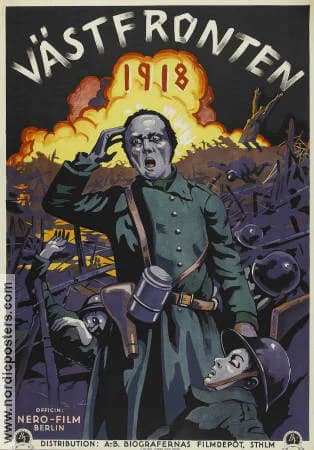
Westfront 1918
Directed by G.W. Pabst193095 minWar
Four German infantrymen (the Bavarian, the Student, Karl, and the Lieutenant) spend the last months of the war in the mud of the Western Front. G.W. Pabst’s 1930 early sound film (from Ernst Johannsen’s novel, Vier von der Infanterie) was the German-produced answer to Lewis Milestone’s All Quiet on the Western Front, released the same year. Where the American film follows the progressive disillusionment of young recruits, Pabst’s version is colder and more episodic: trench collapse, friendly fire, a brief leave home that ends in betrayal, a hand still protruding from a shell-hole. There is almost no rhetoric, only the grinding mechanics of attrition. Gustav Diessl, Fritz Kampers, and Claus Clausen play men already worn down rather than idealists being broken. The final field-hospital image of a dying German and a wounded Frenchman clasping hands ends with the title card “The End?”, a question the Nazis answered by banning the film as defeatist. A stark, intimate counterpart to All Quiet, and one of the purest expressions of Weimar New Objectivity on the screen.
Share this film
Send the watch link, make a branded Story card, or choose an exact 30-second moment when this title is cleared for excerpts.
Share options ready.
Community
Discuss Westfront 1918
Follow durable conversations that selected or mentioned this movie.
No one has started a discussion about this movie yet.
You can be the first.
A private space for every film
Build your own archive
Sign in to log watches, rate films, save thoughts, and return to favorite moments. Nothing is posted publicly.
Sign in to startAbout the film
Four German infantrymen (the Bavarian, the Student, Karl, and the Lieutenant) spend the last months of the war in the mud of the Western Front. G.W. Pabst’s 1930 early sound film (from Ernst Johannsen’s novel, Vier von der Infanterie) was the German-produced answer to Lewis Milestone’s All Quiet on the Western Front, released the same year. Where the American film follows the progressive disillusionment of young recruits, Pabst’s version is colder and more episodic: trench collapse, friendly fire, a brief leave home that ends in betrayal, a hand still protruding from a shell-hole. There is almost no rhetoric, only the grinding mechanics of attrition. Gustav Diessl, Fritz Kampers, and Claus Clausen play men already worn down rather than idealists being broken. The final field-hospital image of a dying German and a wounded Frenchman clasping hands ends with the title card “The End?”, a question the Nazis answered by banning the film as defeatist. A stark, intimate counterpart to All Quiet, and one of the purest expressions of Weimar New Objectivity on the screen.
- Director
- G.W. Pabst
- Year
- 1930
- Runtime
- 95 min
- Genres
- War